back | index
| load
frames
Packages - Editing templates
ATTENTION: ALWAYS BACKUP YOUR TEMPLATES BEFORE
EDITING THEM!!! IF YOU UPGRADE JVMANAGER FROM 3.03 TO ANY VERSION AFTER 3.13 BE
SURE TO CONFIGURE YOUR PACKAGE'S TEMPLATES ACCORDING TO THE INSTRUCTIONS IN THIS
PAGE.
As you can see there are some templates (html and email ones) you can edit
through the "Edit templates" option.
As you also know, when the customer clicks any order link s/he goes to a
first screen where s/he inputs his/her email address, and then to a second
screen where he fills his/her information, selects the payment gateway and
orders.
So in general, we have:
- The GLOBAL templates you can edit through the "Edit
templates" option, and
- The SPECIFIC templates of the "1st order page" and "2nd order page" that
can differ from Package to Package.
If you want to use the same templates for all of your order pages
through all packages then just edit the GLOBAL
templates and leave blank the related textareas when creating a Package.
If you want to use a GLOBAL template for the screens of the "1st order page"
and "2nd order page" and for ALL of your Packages, then here is what to do:
- Click "Edit templates" and
edit the following templates:
- # Default 1st order page
- # Default 2nd order page
- Then whenever you setup and/or edit a Package delete everything inside
the 2 textareas:
- Order template (page 1)
- Order template (page 2)
You can edit the templates of the "1st order page" and "2nd order page" for a
specific Package when you setup/edit a Package. If you want to use a SPECIFIC template for a specific Package, then include
your HTML code inside those textareas:
- Order template (page 1)
- Order template (page 2)
Reminder: the - HTML header and - HTML footer templates inside the "Edit
templates" area are used for the pages related with the administration area
only.
About the #{tags} inside the
Order template (page 1) and Order template (page 2)
Each #{tag} is a piece of code needed by
JVManager. You can edit those templates but you cannot delete those tags. Here
are some exceptions:
APPLIES TO ALL TEMPLATES - DO NOT
DELETE THE FOLLOWING TAGS:
#{header}
#{footer}
Those tags include internal information needed by JVManager and do not affect
your layout.
A. Inside Order template (page 1)
Inside that template you can find the following tags:
#{header}
#{package_title}
#{instructions}
#{products}
#{email_form}
#{footer}
Remember to keep that hierarchy when editing your
page.
Below you can find an example. Study it in order to understand what section
corresponds to each tag:
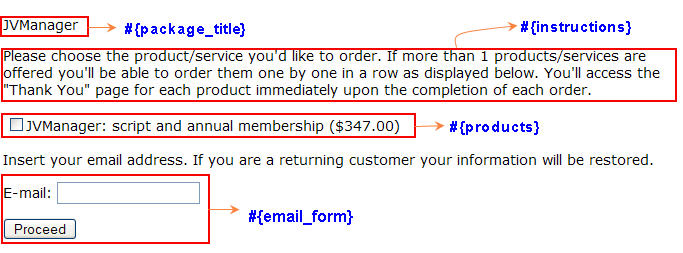
#{package_title}
You can delete this tag and include your own title for that specific Package.
#{instructions}
This tag inserts this paragraph:
"Please choose the product/service you'd like to order. If more than 1
products/services are offered you'll be able to order them one by one in a row
as displayed below. You'll access the "Thank You" page for each product
immediately upon the completion of each order."
You can delete it but be sure to include the instructions your customer
needs.
#{products}
You can delete this tag ONLY if you offer a GROUPED (locked) Package of
Products since the customer cannot select any of the Products. Remember though
to list the products included to that Package and inform your customers that
they have to pay for each of the Products one by one.
B. Inside Order template (page 2)
Inside that template you can find the following tags:
#{header}
#{order_info}
#{aff_identity}
#{billing_info}
#{payment_gate}
#{footer}
Remember to keep that hierarchy when editing your
page.
Below you can find an example. Study it in order to understand what section
corresponds to each tag:
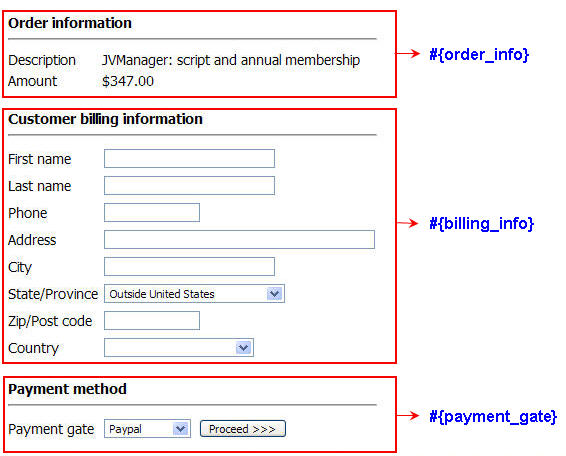
You can delete only the #{order_info} tag
and include your information.
Need more help? Use
www.TurboHelpDesk.com
|
